
Call Center Audit is an objective and evidence-based assessment of individual phone calls, as well as an entire QA program against defined standards.
This is not the same as call monitoring every day.
Call center audits analyze the scoring system itself: is it large enough, is there consistency among evaluators?
Here is everything you need: 7 steps to conduct an audit, the criteria for scoring, and even a free QA Scorecard template for you to use right away.
What Is a Call Center Audit?
Call center audits are done on a macro-level. In daily quality assurance, each call is evaluated one by one: was the tone of voice friendly? Was the agent greeting the customer by his name?
The audit takes a broader view of the issue. Is the scorecard relevant to the needs of the company? Do two different evaluators give the same score to the same call?
The ISO 18295 standard sets the global benchmark for this work. ISO 18295-1 covers requirements for the contact center itself. ISO 18295-2 covers requirements for the businesses that use those centers.
Operational audits analyze metrics such as efficiency and customer satisfaction, for example, First Call Resolution. Compliance audit however, deal only with legal aspect of the work: HIPAA, PCI DSS, TCPA requirements.
Call audit vs. call monitoring vs. quality assurance: three terms teams confuse
Teams mix up these three terms all the time, and it’s a mix-up causes real issues in the longrun. Here is the clean split:
- Quality Assurance (QA): The overarching strategy aimed at ensuring that calls comply with company standards. That’s the plan.
- Call Monitoring: The ongoing practice of listening to the calls and evaluating them according to the plan. It happens on a daily basis, per-call.
- Call Audit: A distinct procedure focused on reviewing the quality monitoring itself. Is the sample large enough? Is the weight distribution correct? Are the evaluators calibrated?
Why Call Center Audits Matter
Compliance exposure, CSAT/DSAT correlation, coaching ROI, script adherence
- Compliance exposure. Call centers sit in a high-risk spot for legal trouble. Under the Fair Debt Collection Practices Act, a debt collector who skips the required Mini-Miranda disclosure opens the company up to steep penalties. PCI DSS Requirement 3.3.1, requires that once a payment transaction has been completed, no business shall ever store the card verification code or the PIN block of a customer. The audit will make sure that your recording system stops and mutes in the correct instant.
- CSAT/DSAT correlation. Call quality and First Call Resolution (FCR) move customer satisfaction almost like clockwork. SQM Group's benchmarking puts the average FCR rate across industries between 70% and 75%. Their data shows something close to a 1-to-1 relationship: raise FCR by 1%, and CSAT rises about 1% too, while operating costs drop roughly 1%. On the flip side, CSAT falls by about 15% every time a customer has to call back about the same problem.
- Coaching ROI. Bad quality costs real money. Each avoidable repeat call runs a business somewhere between $5 and $8. For a center with 500 agents, a 1% bump in FCR can save about $286,000 a year just from fewer repeat calls. That same 1% FCR gain also lifts agent satisfaction by roughly 2.5%, which matters in an industry that loses staff fast.
- Script adherence. A script read word for word can sound robotic and hurt the conversation. But in regulated industries like healthcare and finance, some lines cannot be skipped. Audits help tell the difference between an agent who lacked warmth and an agent who skipped a legally required step.
The 7-Step Call Center Audit Process
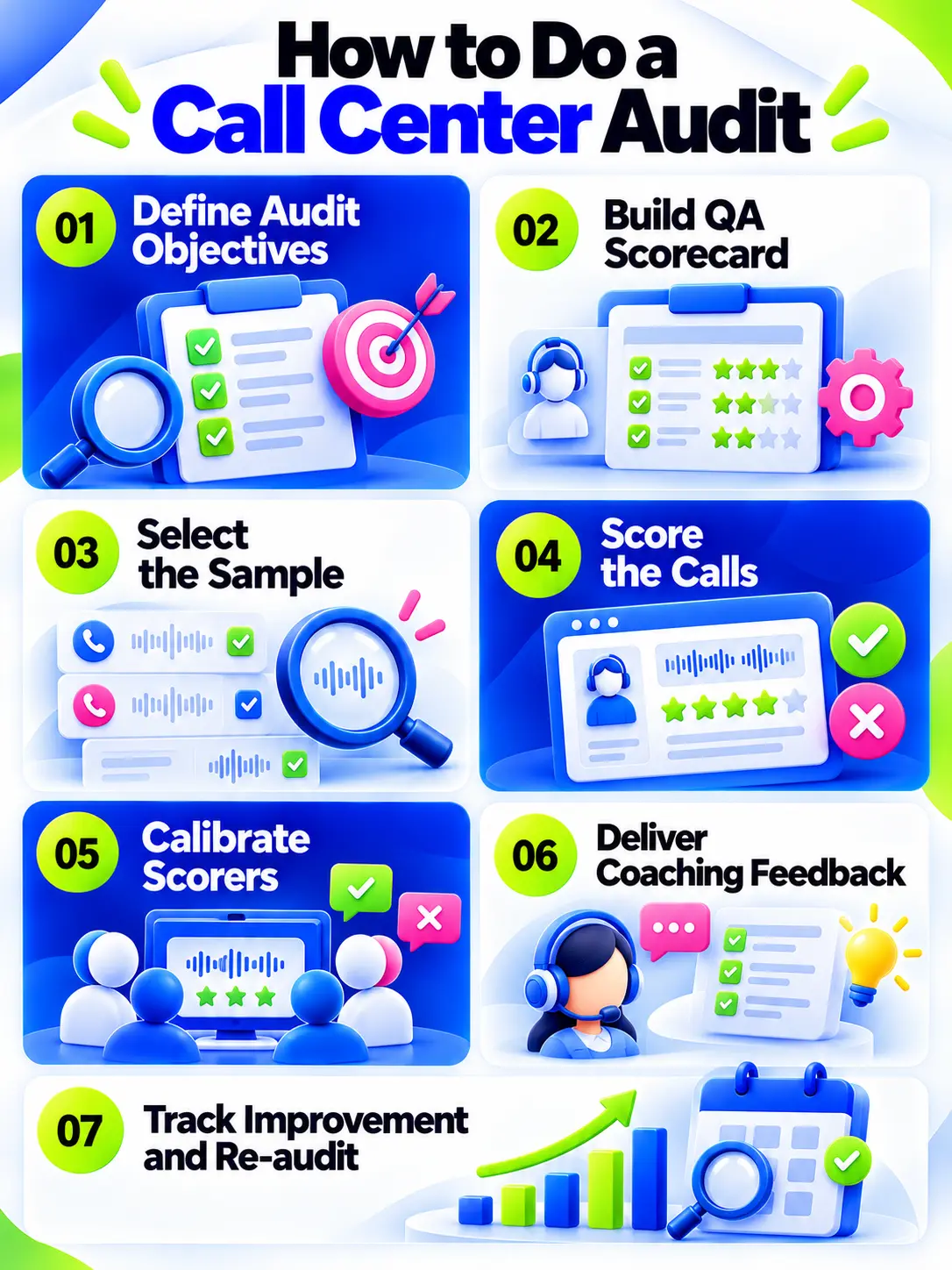
Step 1: Define audit objectives and scope
First, determine what the purpose of the audit actually is. Compliance? Performance? Or process failure? Then establish the scope of your audit: which channels (call, chat, email), what kind of agents (new vs. veteran), what type of calls, and in which time frame.
- The COPC CX Standard is clear that objectives need to line up with both business goals and client requirements.
- If abandonment rates are spiking, narrow the scope to peak-hour queues.
- If legal risk is the concern, narrow it to script and disclosure compliance.
Step 2: Build the QA scorecard
A scorecard turns your goals into things you can actually measure. Categorize the criteria based on the call phases: greeting, discovery, resolution, tone and wrap-up.
- Each individual criterion must either have binary ratings (pass/fail) or scaled ratings (e.g., 1-5). At least some of the criteria should have fatal errors, meaning they will automatically fail an entire call.
- Skipping identity verification is a good example, it should zero out the score no matter how polite or efficient the rest of the call was.
- The biggest mistake here is cramming in too many vague criteria. That overloads evaluators, adds bias, and waters down the coaching that follows.
Step 3: Select the sample (and why random sampling misses the worst calls)
This step causes the most trouble in a manual audit. For years, the industry norm has been to review 1% to 3% of calls by hand, which works out to about 5 to 6 calls per agent each month. The COPC CX Standard sets a floor of 4 evaluations per agent per month.
- Here's the problem: pure random sampling is bad at catching rare, serious mistakes. Say an agent makes a fatal compliance error on just 1% of their 1,000 monthly calls, meaning 10 bad calls out of 1,000.
- A random sample of only 5 calls has a real chance of missing all 10. That's not a small gap. It means the worst calls, the ones that actually create legal exposure, are the ones most likely to slip through.
- The solution is risk-based sampling, also called stratified sampling. Make use of speech analytics to identify calls with lengthy holds, risks, or negative keywords, then manually select the sample based on those calls rather than randomly selected calls. You would be reviewing less volume of calls while focusing on more important ones.
Step 4: Score the calls
Call scoring works best when you grade only what you see, not what you think. Instead of asking yourself, "Was the agent polite?" ask, "Did the agent use the client's name and say goodbye properly?" It's a matter of yes or no.
- Weight resolution and accuracy higher than small administrative steps, since those drive the outcomes that matter most.
- Write down the exact timestamp and context behind every score, especially a failing one.
- A number with no evidence behind it makes the coaching conversation weak and easy to argue with.
Step 5: Calibrate scorers to eliminate rater drift
Calibration makes sure Evaluator A and Evaluator B score the same call the same way. Without it, "rater drift" creeps in: personal bias, fatigue, and shifting standards slowly pull scores apart.
- The Quality Assurance and Training Connection (QATC) and the COPC CX Standard both call for regular calibration sessions.
- In these sessions, a group of evaluators scores the same "anchor call" on their own, then compares notes and talks through any gaps.
- Most standards aim for 95% to 100% agreement between evaluators.
Step 6: Deliver coaching feedback
A score is meaningless if it fails to affect behavior. The feedback should be precise, immediate, and supported by proof. Your compliance score was 72% tells an agent nothing useful. However, at the 2:14 mark, you skipped the second identity check" tells them exactly what to fix.
Coaching should never feel like punishment.
Forcing scores into a bell curve, where managers have to label some solidly good agents as low performers just to fit the curve, is one of the clearest ways to tank morale and drive good people out the door.
Step 7: Track improvement and re-audit
One audit is a snapshot, not the full picture.
- Track each agent's scores over time to see if coaching is working.
- Also track team-level trends: if five different agents keep failing the same criterion, that's not five bad agents, that's probably a broken knowledge base article or an outdated process.
- Go back and re-audit the specific risk areas you flagged, to confirm the fix actually worked.
What to Score: Call Center Audit Criteria
A good scorecard balances hard compliance rules with the softer skills that shape a customer's experience.
Free Call Center QA Scorecard Template
Embedded/downloadable — the single biggest gap in this SERP
Most "free scorecard templates online turn out to be a plain bulleted list with no real math behind it. This one has actual point values, built-in fatal errors, and a clear passing target, so you can start scoring calls with it right away.
Header fields: Agent Name / Evaluator Name / Call ID & Date / Interaction Type (Sales, Support, Collections, Healthcare)
Compliance Checks Every Audit Should Include
PCI-DSS, HIPAA, TCPA, mini-Miranda, CMS recording
A call center often has to answer to several regulators at once. Every audit should check for these, depending on the industry:
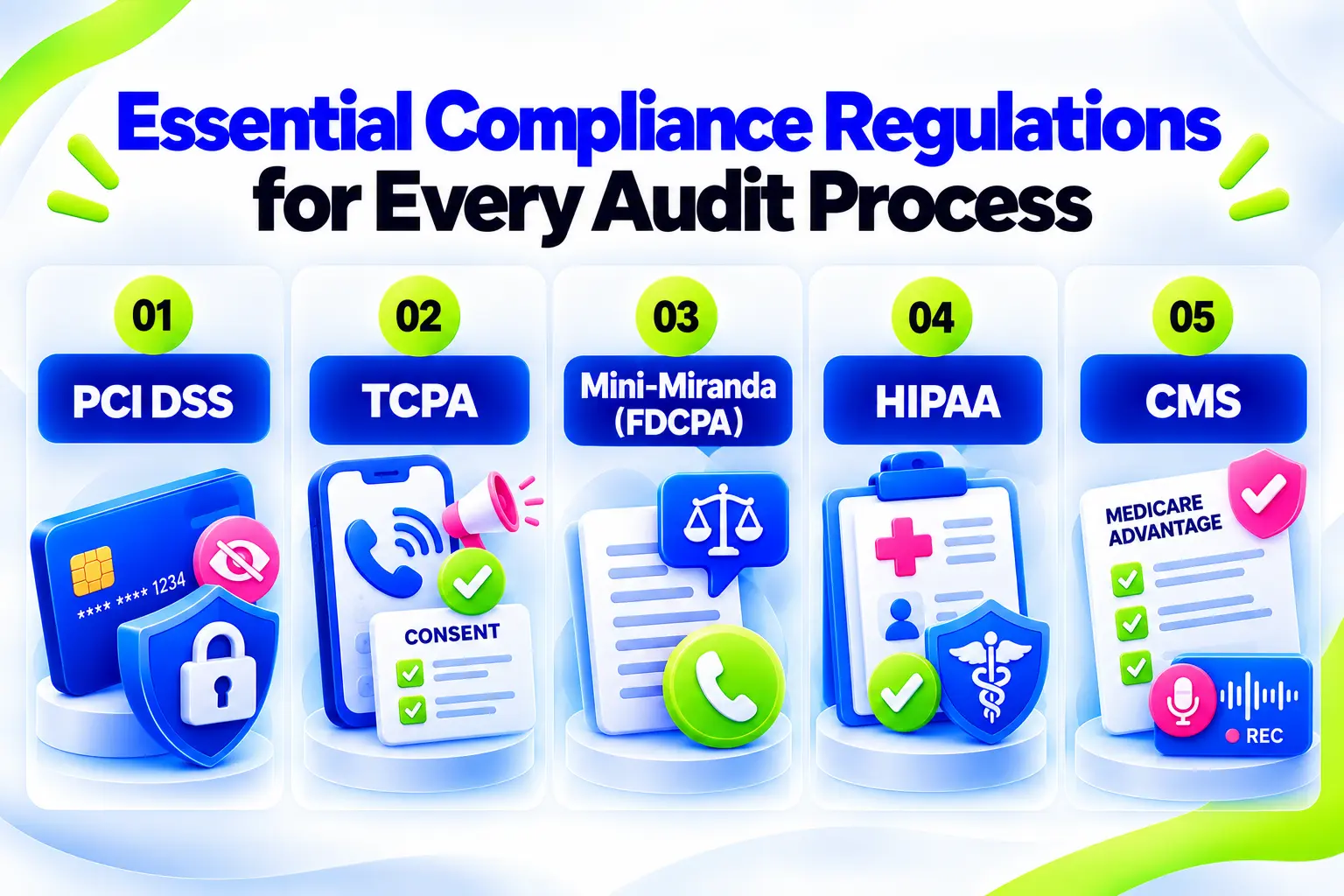
- PCI DSS: Applies to any center that takes payments. Under Requirement 3.3.1, sensitive data like the card's CVV or PIN block can never be stored once the payment goes through. Audits need to confirm the pause-and-resume recording system is actually muting that part of the call.
- TCPA: Governs outbound telemarketing, auto-dialers, and prerecorded messages. Audits need to confirm the business has documented, written consent on file before certain outreach happens.
- Mini-Miranda (FDCPA): In third-party debt collection, agents must open the call by saying this is an attempt to collect a debt and that anything shared will be used for that purpose. Leaving this out is a serious violation and should be built into the scorecard as an automatic fail.
- HIPAA: In healthcare, audits need to confirm agents only share the minimum information necessary, and that callers are properly verified before any clinical or billing details come up.
- CMS: For Medicare Advantage and other healthcare plans, audits need to confirm strict adherence to approved benefit language and that enrollment calls are being recorded as required.
Manual Auditing vs. AI Call Auditing
The industry is shifting fast from manual sampling toward AI-driven QA, mostly because humans can't realistically review every call. But treating AI as a flawless replacement for a person's judgment is its own kind of mistake.
The accuracy of the ASR software is measured using the word error rate (WER). This method involves summing the number of substituted, deleted, and inserted words, then dividing by the total number of words in the reference transcript.
- Background noise, crosstalk, and regional accents all push this number up. And Apple's machine learning research found that WER can be misleading on its own, since it penalizes every error equally, even small ones that don't change the meaning.
- Their Human-Evaluated WER, which only counts errors that actually change the meaning, came in far lower in their testing (1.4% versus 9.2% under standard WER) a reminder that raw WER numbers alone don't tell the whole story.
- Large language models bring their own risk. Gistly's research puts hallucination rates for these models between 3% and 27%. In a center handling 10,000 calls a day, a 3% hallucination rate means roughly 300 calls get scored against made-up conversation data.
- According to ETS Labs real-time sentiment analysis produces 15% to 30% false positives, which makes the attention of the supervisor go off quickly. “As Speechmatics notes, a single misnamed individual can make far more difference to a legal case than the dropping of filler words, which means accuracy claims must be scrutinized based on where the errors occur,” according to the New Republic.
- The solution most teams tend to arrive at is an integrated approach where AI evaluates 100 percent of calls for abnormalities, and then a human quality assurance analyst checks the calls marked by AI before coaching.
How Often Should You Audit Your Calls?
It’s impossible to say there’s one correct frequency. In the end, this will depend on your level of risk and the experience of your agents. But the standards organizations provide you with a great starting point:
- Agent-level QA: 4 to 6 calls per month for experienced agents; double to triple that number during their first 90 days.
- QA calibration: Weekly or biweekly sessions to keep evaluators aligned and catch rater drift early.
- Program-level audit: A full structural review of the QA process, scorecard relevance, and AI model accuracy (checking WER and false-positive rates), done quarterly.
Common Call Audit Mistakes
- Relying only on random samples. Pure random sampling almost guarantees that rare, serious compliance errors go unnoticed until they've become a real liability.
- Overweighting Average Handle Time. Punishing agents for a longer call directly fights against First Call Resolution. Rushed agents don't fix the root cause, which just drives up costly repeat calls.
- Treating QA as punishment. Forced distribution scoring, where managers must label some perfectly good agents as "low performers" to fit a curve, kills morale and pushes good agents to quit. Frontline agents on industry forums often describe QA teams as picking out the worst calls to meet a quota; whether or not that's the intent, it shows how quickly trust breaks down when scoring feels arbitrary.
- Treating AI as infallible. Letting AI score and discipline agents with no human check ignores real problems like hallucinations, transcription errors, and false positives that come with the technology today.
Frequently Asked Questions
What is a call center audit?
It's a structured review of both individual calls and the QA program behind them, checked against performance, compliance, and process standards. It's broader than daily call monitoring.
What is the difference between call monitoring and call auditing?
Monitoring is the daily work of scoring individual calls. Auditing is a separate, periodic check of whether the monitoring process itself, meaning sample size, scorecard design, and evaluator consistency, is actually working.
What should be included in a QA scorecard?
Criteria grouped by call phase (greeting, discovery, resolution, tone, wrap-up), a mix of binary and scaled scoring, and built-in fatal errors for serious compliance failures.
What are fatal errors in call center QA?
A fatal error is a mistake serious enough to fail the entire call automatically, no matter how well the rest of it went. Skipping identity verification or a required legal disclosure are common examples.
How many calls should QA audit per agent?
Most standards call for at least 4 to 6 calls per agent per month, with more for new hires. But volume alone isn't enough — risk-based sampling catches far more than random sampling at the same volume.
Why is random sampling ineffective for compliance monitoring?
Because rare, serious errors are, by definition, rare. A small random sample has a real chance of missing all of them, even when they're happening regularly across an agent's full call volume.
Can AI replace manual call center QA?
Not entirely, at least not yet. AI can score every call, but current hallucination rates and transcription errors mean a human still needs to review flagged or high-risk calls before any coaching or discipline happens.
How does First Call Resolution (FCR) affect CSAT?
Very directly. Industry data shows roughly a 1-to-1 relationship: a 1% rise in FCR tends to produce about a 1% rise in CSAT, while a forced callback drops CSAT by around 15%.



.png)