Are you monitoring the right call center KPIs, or just generating data that looks nice in a dashboard?
With the right KPIs for call centers, you can see which areas of your operation are doing well, where your customers have issues, and where improvements can be made.
From FCR and AHT to CSAT and abandoned calls, here are 10 critical call center KPIs that you can use to measure performance and make better decisions.
Why Should Enterprises Track These Call Center KPIs?
When you track call center KPI metrics consistently, you can finally set clear performance goals and make smart decisions that actually lead to real business results.
- Stop Guessing What Customers Want: These call center KPIs are your direct window into what your customers are actually going through. This is how you find out what's causing headaches and what's making them happy.
- Make Performance Reviews Easier: With hard data, there is nothing left to wonder about. You can set realistic goals for your agents, and they know what to strive for.
- End Inconsistency: Ever worry that your customers' experience depends entirely on which agent they happen to get? The use of KPI in call centers put an end to that. They set a quality standard for everyone, so your customers get great support every single time.
- Spot Trouble Before It Explodes: A sudden dive in CSAT scores or a spike in abandoned calls isn't just a blip on a chart; it's a giant red flag. tracking call center KPI metrics helps you keep an eye out for this.

10 Key Call Center KPIs that all Businesses Should Track
Don't think of these as call center metrics for the sake of metrics.
Think of them as tools to improve customer experience. Or for better insight:
1. First Call Resolution
FCR stands for First Contact Resolution, which pertains to how effective an agent can handle and resolve the problem faced by the customer on the first contact.
- Maintaining high FCR means satisfied customers and efficient working staff.
- In order to do so, equip your agents with appropriate training, database access, and the power to resolve the problem independently.
- First Call Resolution is a foundational call center KPI. And while it started with phone calls, the "one-touch resolution" principle is the gold standard for delivering an excellent customer experience on live chat, email, and social media.
2. Average Handle Time (AHT)
I've seen teams obsess over this KPI in call centers, but the reality is that it’s fine for your agents to spend more time on the call. It shows customers you care!
Simply put, the average handle time refers to the amount of time it usually takes to complete a call.
- However, while low AHT may seem like a sign of increased efficiency on the part of your team, it is important that you take care to keep your customers satisfied, too, and there’s no doubt about the fact that they know when you are rushing them.
- What would be the point of a fast call if they need to make three more calls after that?
3. Customer Satisfaction (CSAT)
This is typically a straightforward way to find out how happy they are. This is usually done by a quick survey where customers give you a rating on a scale or by using emojis.
By keeping an eye on your CSAT scores, you get the unfiltered truth about how your agents and processes are actually performing. No sugarcoating.
4. Average Speed of Answer (ASA)
Average Speed of Answer is all about how quickly your agents are picking up the calls that are waiting in line.
- It gives you a good idea of how easy it is for customers to reach your team, which has a direct impact on their frustration levels.
- That's why a high ASA leads to more people hanging up. I mean, do you enjoy listening to terrible hold music for ten minutes? Of course not.
5. Call Abandonment Rate or Average Abandonment Rate
This KPI for call centers helps to monitor the ratio of clients who have abandoned the call before even connecting to an agent.
- One should treat a high rate of abandonment as a signal, since there is usually something wrong behind it.
- Regardless of the reason, this indicator demonstrates those opportunities that were missed to be able to serve a client and retain their loyalty.
6. Net Promoter Score (NPS)
The technique requires only one question that is extremely easy yet powerful. How probable is it on a scale of 0 to 10 that you will recommend our firm to your colleagues/friends?
Then people are categorized into three categories: Promoters (9-10), Passives (7-8), and Detractors (0-6).
The calculation of the Net Promoter Score becomes extremely easy as all that is required from you is to subtract detractors from promoters.
However, NPS is not significant for the call centers industry even though it is helpful in assessing your brand reputation.
7. Customer Effort Score (CES)
Ready for a shocking concept? Customers want things to be easy.
CES looks at how much effort a customer had to put in to get their problem sorted out.
To figure this out, customers are asked to rate how easy their experience was. It turns out that when customers don't have to write a novel and fax it to three different departments, they are much more likely to stick around.
8. Customer Churn Rate (CCR)
The Customer Churn Rate refers to the percentage of customers that you lose during a particular period of time.
The reality is that interactions with customer service can heavily influence how this ends up going.
Churn rate is a call center KPI metric that gives you insight you can use to plan better customer retention strategies.
9. Average After Call Work Time (AWT)
Also known as Wrap-Up Time, AWT is the time an agent spends on tasks after they've hung up with a customer you know, all the fun stuff.
This work usually involves logging notes, updating the CRM, or shooting off follow-up emails.
While all of this is necessary, figuring out how to do it more efficiently is a key way to free up your agents to be more available and productive.
10. Occupancy Rate
The Occupancy Rate tells you what percentage of an agent's logged-in time is spent actively working on call-related tasks, compared to their total available time.
On one hand, a high occupancy rate can signal efficiency, but on the other, if it stays too high for too long, it can lead straight to agent burnout.
That's why it's such an essential call center KPI to watch for planning out your resources and managing your team.
How AI Helps Track Call Center KPIs
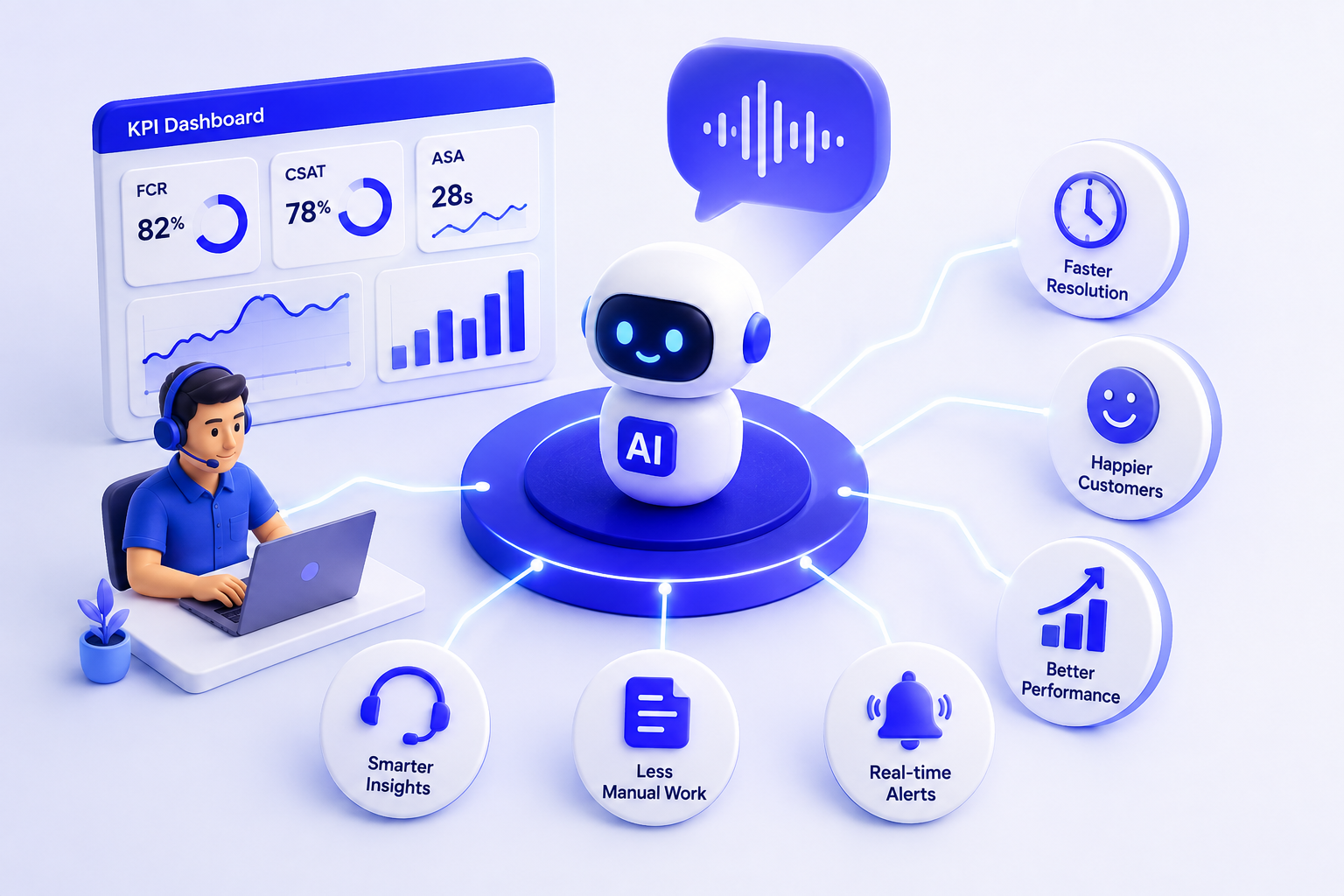
Checking a small sample of calls manually is not sufficient to assess contact center performance in its entirety. Conversation intelligence powered by AI technology allows analyzing transcripts, assessing interactions in a consistent manner, identifying customers’ sentiment, and detecting trends among more conversations.
AI can help teams:
- Conduct analysis on more interactions: Conduct analyses on interactions rather than sampling at random.
- Consistent Quality Assurance: Adopt the same standard for quality assurance.
- Find out the causes: Find out repetitive customer complaints, extended holding times, transfers, and so forth.
- Decrease after-call tasks: Summary, disposition, and CRM notes can be automated.
- Act swiftly: Dashboards and alerts should be used to detect deteriorating KPIs.
Why Use Thunai to Track Call Center KPIs?
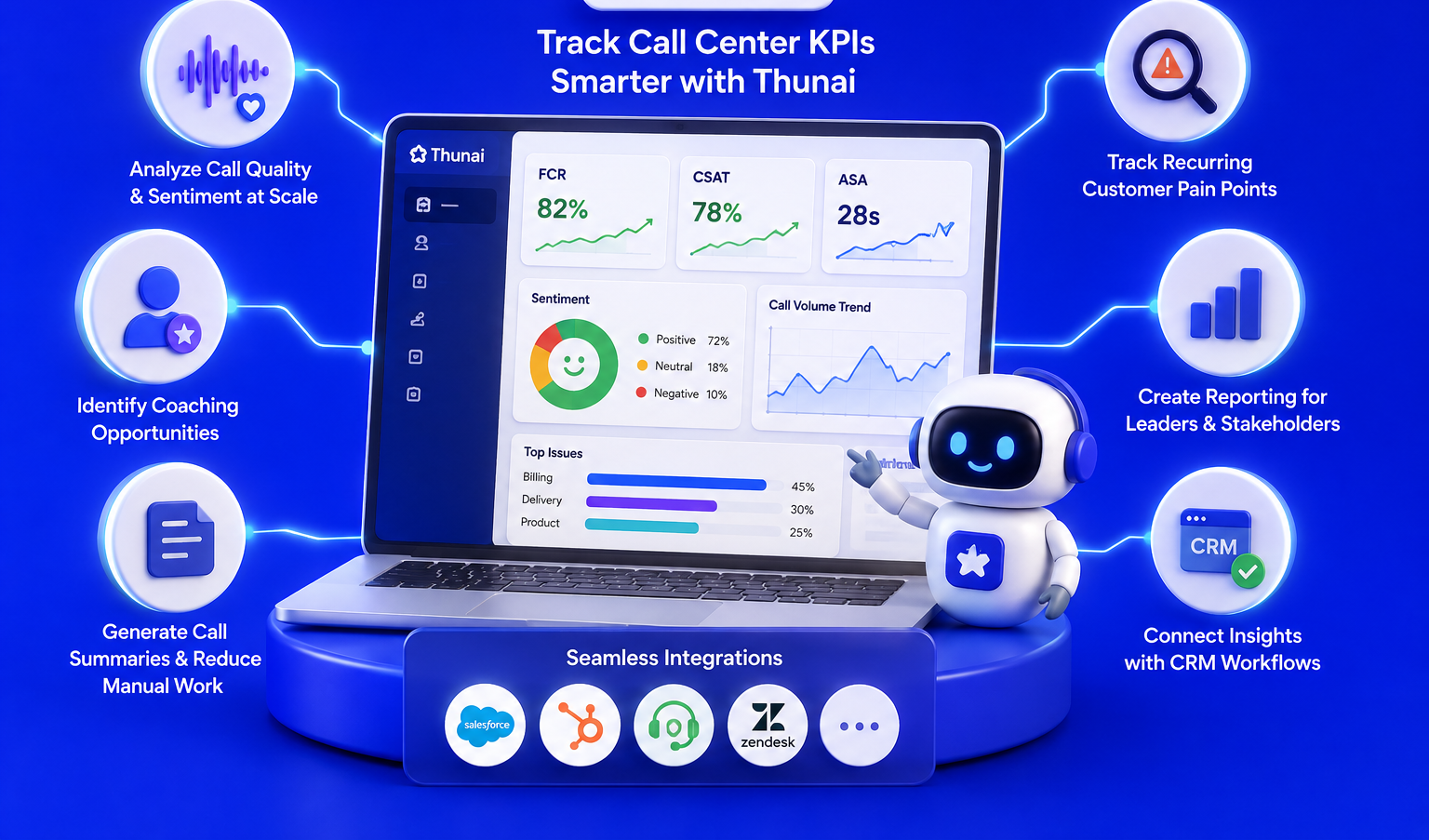
Thunai can help contact center teams capture and analyze conversation data, identify trends, and make KPI reporting more actionable. Before publishing, ensure every product capability claim on this page is supported by current Thunai product documentation or a live demonstration.
With the right call center and CRM integrations in place, a conversation intelligence platform can help teams:
- Analyze call quality and customer sentiment at scale
- Identify coaching opportunities from real conversations
- Generate call summaries and reduce manual documentation
- Track recurring customer pain points
- Create reporting for operations leaders and stakeholders
- Connect conversation insights with CRM workflows
Ready to evaluate how your support conversations affect customer experience and operational performance? Try Thunai for free.
FAQs on Call Center KPIs
What are the standard KPI benchmarks for call centers?
Wish I could give you a magic number, but there isn't one. KPI standards can really change from one industry or company to another. However, some common goals to shoot for include a CSAT of 80% or higher, an ASA under 30 seconds, and a Call Abandonment Rate below 5%. It's always a good idea for a business to set its own standards based on its own history, not just what some other company is doing.
What's the difference between a KPI and a KRA in a BPO?
In the Business Process Outsourcing (BPO) world, a KPI (Key Performance Indicator) is a specific number you track to check performance against a goal (like an AHT of 300 seconds). A KRA (Key Result Area), on the other hand, is a broader outcome that a person or team is responsible for (like Improving Customer Retention).