
Businesses today move faster than manual workflows can handle. Customer expectations are rising, support volumes are growing, and teams are overwhelmed by repetitive tasks.
Many companies tried basic automation or chatbots, but these tools often fail to complete real work or deliver meaningful ROI.
This is where AI agents for business are changing the game.Unlike traditional automation, AI agents can understand context, plan tasks, and execute actions across multiple systems.
Platforms like Thunai help companies automate customer service, sales, and internal operations with intelligent agents.
In this guide, we explore how AI agents work, their benefits, and how businesses can deploy them successfully.
What Are AI Agents for Business?
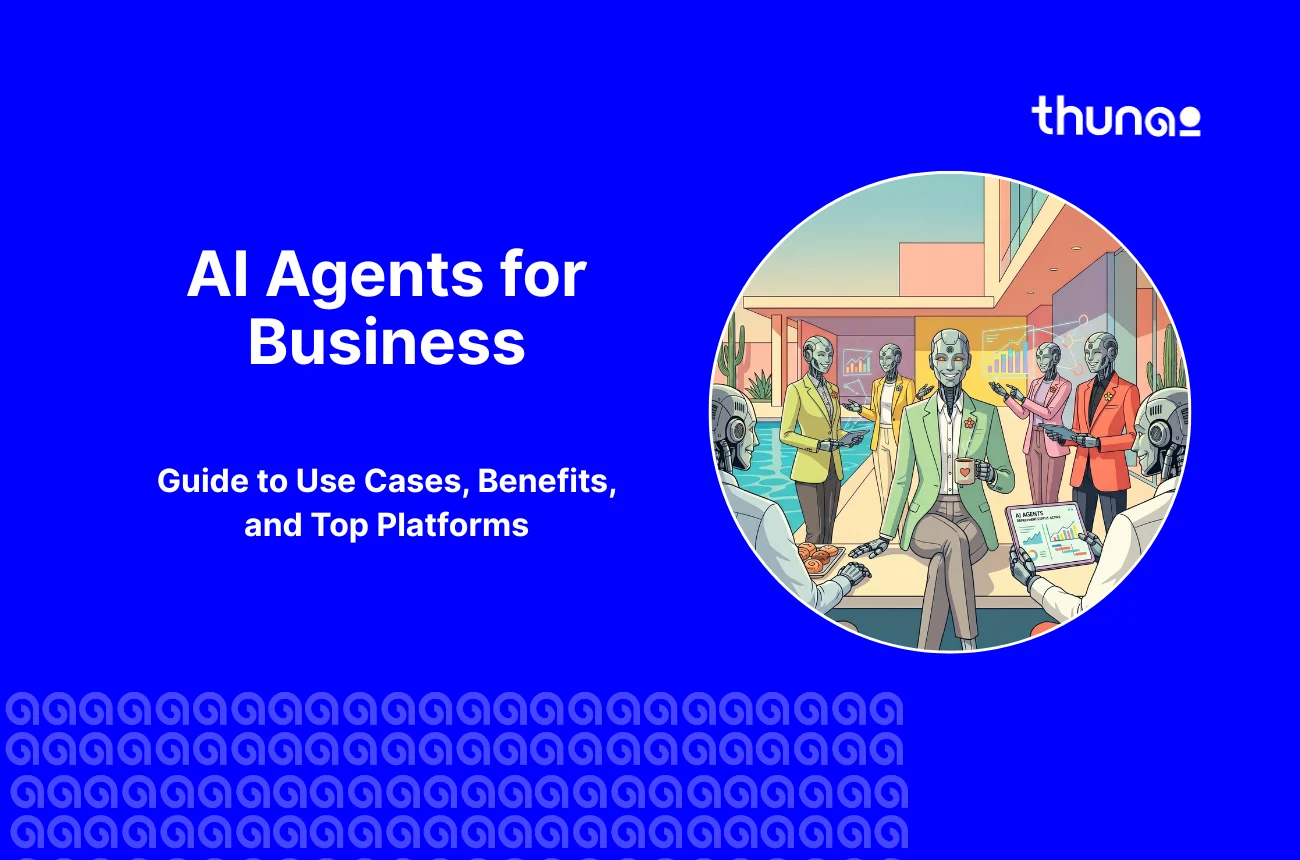
An AI Agent for Business is a digital worker that uses advanced models to see its environment, make plans, and perform tasks across software without a person stepping in.
They differ from the bots of the past because they operate in loops. They find intent, search for data, propose a path, and check if the result is good before finishing.
.webp)
Technical Differences: Agents, Chatbots, and RPA
- Distinguishing these tools is key for your tech spend.
- Old school automation, like RPA, works at the interface level. It follows set rules to move data. If a button moves, RPA fails.
- Chatbots mainly handle natural language to answer questions and point people to links.
- AI Agents for Business bring reasoning and action together.
- They do not need scripts. They use context to move through messy tasks.
Key Powers: Reasoning, Memory, Action, and Learning
The functional strength of AI Agents for Business comes from four pillars:
- Reasoning and Planning: These agents break big goals into small steps. They look at many paths and pick the best one based on company rules.
- Context Memory: Top agents keep a unified memory. They fix conflicts across different data pools, like CRM notes and emails, to find one truth.
- Multimodal Action: These tools do not just write. They use APIs to update files, take payments, and manage schedules across tools like Salesforce or Slack.
- Self Learning: These systems take in feedback to get better. This helps them improve success rates without a person needing to update any code.
Types of AI Agents Used in Business
In 2026, the idea of one AI for everything is dead. We use a multi agent setup where specialized workers collaborate.
- Customer Service Agents.
- These are the most common agents.
- 80 percent of service firms plan to use them by the end of 2026.
- They manage chat, voice, and email with an 80 percent success rate on their own.
- Sales Intelligence Agents.
- These agents automate the early work that takes too much human time.
- They research accounts, score leads, and write outreach that fits the prospect.
- They link with CRM tools to find deals at risk and give reps real time tips during calls.
- IT Service Management Agents.
- In IT, agents remove the boring work.
- They handle password resets, check IDs via MFA, and give out software licenses.
- They resolve issues in seconds rather than hours.
- HR and Employee Support Agents.
- HR agents help from the first day to the last.
- They automate the tasks of onboarding and help staff with policy questions.
- This improves case success rates by 35 percent.
- Knowledge Management Agents.
- These agents fix the problem of hidden data.
- They pull info from PDFs and meeting notes to build a brain for the firm.
- They find conflicts in manuals and fix them, which stops hallucinations by 95 percent.
- Data Analysis and Reporting Agents.
- Data agents act as analysts.
- They query pools of data and build reports from plain language prompts.
- They track KPIs in real time and find odd shifts in the numbers.
Top AI Agent Use Cases by Business Function
The value of AI Agents for Business is best seen in action. We now center on AI led workflows where people only step in for the hardest cases.
- Customer Service: Autonomous Success The main goal is lifting satisfaction scores via instant fixes. Agents handle 80 percent of queries without a person. They use voice support in 150 languages to ensure global reach.
- Sales: Lead Scoring and Deal Intelligence Sales teams use agents to speed up the pipeline. Agents look at how people use the site to score leads, ensuring reps look at the best prospects. They also predict revenue by looking at every email and call.
- IT and Operations: Self Service IT teams use agents to create a self healing setup. Agents categorize tickets and resolve common issues like VPN access immediately. They also watch system health and start recovery steps if they see a problem.
- HR: Onboarding and Policy HR agents improve how employees feel about the firm. They coordinate onboarding steps, from kits to security checks. Staff get instant answers about benefits from the latest documents.
- Finance: Invoice and Expense Finance agents ensure things are right in high volume areas. They match invoices to orders and flag errors. They also review expenses in real time to stop policy breaks.
The Business Case for AI Agents: ROI and Benefits
The move to AI Agents for Business is about the money. AI led workflows have tripled their profit share since 2022.
ROI Benchmarks and Cost Savings Market leaders see big gains. Firms using these agents report revenue growth between 3 and 15 percent.
Key Powers: Reasoning, Memory, Action, and Learning
The functional strength of AI Agents for Business comes from four pillars:
- Reasoning and Planning: These agents break big goals into small steps. They look at many paths and pick the best one based on company rules.
- Context Memory: Top agents keep a unified memory. They fix conflicts across different data pools, like CRM notes and emails, to find one truth.
- Multimodal Action: These tools do not just write. They use APIs to update files, take payments, and manage schedules across tools like Salesforce or Slack.
- Self Learning: These systems take in feedback to get better. This helps them improve success rates without a person needing to update any code.
Types of AI Agents Used in Business
In 2026, the idea of one AI for everything is dead. We use a multi agent setup where specialized workers collaborate.
- Customer Service Agents.
- These are the most common agents.
- 80 percent of service firms plan to use them by the end of 2026.
- They manage chat, voice, and email with an 80 percent success rate on their own.
- Sales Intelligence Agents.
- These agents automate the early work that takes too much human time.
- They research accounts, score leads, and write outreach that fits the prospect.
- They link with CRM tools to find deals at risk and give reps real time tips during calls.
- IT Service Management Agents.
- In IT, agents remove the boring work.
- They handle password resets, check IDs via MFA, and give out software licenses.
- They resolve issues in seconds rather than hours.
- HR and Employee Support Agents.
- HR agents help from the first day to the last.
- They automate the tasks of onboarding and help staff with policy questions.
- This improves case success rates by 35 percent.
- Knowledge Management Agents.
- These agents fix the problem of hidden data.
- They pull info from PDFs and meeting notes to build a brain for the firm.
- They find conflicts in manuals and fix them, which stops hallucinations by 95 percent.
- Data Analysis and Reporting Agents.
- Data agents act as analysts.
- They query pools of data and build reports from plain language prompts.
- They track KPIs in real time and find odd shifts in the numbers.
Top AI Agent Use Cases by Business Function
The value of AI Agents for Business is best seen in action. We now center on AI led workflows where people only step in for the hardest cases.
- Customer Service: Autonomous Success The main goal is lifting satisfaction scores via instant fixes. Agents handle 80 percent of queries without a person. They use voice support in 150 languages to ensure global reach.
- Sales: Lead Scoring and Deal Intelligence Sales teams use agents to speed up the pipeline. Agents look at how people use the site to score leads, ensuring reps look at the best prospects. They also predict revenue by looking at every email and call.
- IT and Operations: Self Service IT teams use agents to create a self healing setup. Agents categorize tickets and resolve common issues like VPN access immediately. They also watch system health and start recovery steps if they see a problem.
- HR: Onboarding and Policy HR agents improve how employees feel about the firm. They coordinate onboarding steps, from kits to security checks. Staff get instant answers about benefits from the latest documents.
- Finance: Invoice and Expense Finance agents ensure things are right in high volume areas. They match invoices to orders and flag errors. They also review expenses in real time to stop policy breaks.
The Business Case for AI Agents: ROI and Benefits
The move to AI Agents for Business is about the money. AI led workflows have tripled their profit share since 2022.
ROI Benchmarks and Cost Savings Market leaders see big gains. Firms using these agents report revenue growth between 3 and 15 percent.
The True Cost of Ownership As a CEO, you must know the real price. The initial quote is only 60 percent of the total spend. You must factor in data prep, security fixes, and keeping the models current. The formula for the first year is the vendor quote times 1.5.
Productivity Gains Beyond money, AI Agents for Business give back time. Some firms cut document work from 20 hours to 15 minutes. Specialists like devs finish tasks 126 percent faster. This lets your talent look at the grand goals of the firm.
1. Thunai
- Unified Intelligence (Thunai Brain): Centralizes scattered data to eliminate knowledge silos and improve decision making.
- High Accuracy AI: Reduces hallucinations by up to 95%, ensuring reliable responses.
- ThunaiOmni + Multilingual: Handles voice and chat across 150+ languages seamlessly.
- Rapid Deployment: Can go live in under 48 hours, enabling quick ROI.
2. Salesforce Agentforce
- CRM Natively Integrated: Seamless integration into the Salesforce environment.
- Reasoning by Atlas: Automation of complicated activities and decisions.
- RAG driven Data Retrieval: Use of real-time data in action execution.
- Automation of Workflows: Record updates, order processing, and CRM related tasks.
3. Zendesk AI
- Pre-built Intelligence: Developed using billions of actual customer support engagements.
- Procedure Builder: Automates each process step by step to ensure quality service delivery.
- Quality Assessment Tools: Evaluates every interaction performed through the platform.
- Perfectly Integrated Into Zendesk: Best-suited for companies utilizing the Zendesk platform.
4. Ada
- Large Volume Automation: Built to cope with high volumes of customer engagements.
- Reasoning Engine: Facilitates smart reasoning in conversation flows.
- Playbook Automation: Automates playbooks via live data.
- E-commerce Optimization: Specializes in rapid, scalable solutions within e-commerce.
5. Cognigy.AI
- Enterprise Voice Centered on: Designed for heavy duty telephony scenarios.
- Voice Gateway: Delivers low latency and quality voice transactions.
- Scalable Architecture: Manages difficult workflows in sectors such as banking and aviation.
- Omnichannel Automation: Goes beyond voice into messaging and chat channels.
6. Intercom Fin
- End to End Resolution: Capable of solving customer queries entirely without human assistance.
- Flywheel Learning: Keeps improving performance by learning from each interaction.
- Outcome-Based Billing: Charged at $0.99 for each resolution made.
- Saas Specific: Customized to fit Saas Customer Support requirements.
7. Moveworks
- Internal Automation: Focused on IT and HR service desk operations.
- Task Execution: Automates actions like password resets and account unlocks.
- Knowledge Studio: Identifies and fills knowledge gaps for better responses.
- Enterprise Tool Integration: Works across multiple internal systems seamlessly.
8. Forethought
- Proactive Support AI: Anticipates customer needs across channels.
- High Accuracy: Achieves up to 92% accuracy in responses.
- AI Triage System: Routes tickets intelligently to the right teams.
- Multichannel Coverage: Supports voice, chat, and email interactions.
How to Choose the Right AI Agent Platform for Your Business
Picking a platform needs you to match goals with tech.
- Business Goal Fit: Decide if you need an external face for the brand or internal help.
- Connection Depth: The platform must link to your current tech stack. Salesforce fits CRM led firms, while Thunai connects 50 plus tools fast.
- Governance and Security: Firms in regulated fields need high guardrails and human in the loop checks for money tasks.
- Speed of Deployment: Choose between agents that start in days or custom systems that take months but offer more.
- Total Cost: Look at the price per success and factor in the 40 percent overhead for data work.
How to Deploy AI Agents for Your Business: A 90-Day Roadmap
Moving to a digital agency needs a steady plan.
- Month 1: Foundation and Strategy Find high volume, low complexity tasks. These are the low hanging fruits. Audit your data to see if it is ready.
- Month 2: Setup and Testing Build the brain of your agent by uploading verified files. Map the flows and set guardrails for risky actions. Use experts to test the reasoning.
- Month 3: Go Live and Bettering Deploy to a small group first. Watch the metrics every day and tune the logic. Scale to other teams once the pilot works.
Common Mistakes When Deploying AI Agents for Business (And How to Avoid Them)
Avoid these traps to succeed:
- No Verified Knowledge Base: Agents need good data. Old manuals lead to lies.
- No Path to a Person: Always have a handoff for hard cases.
- Ignoring CSAT: Do not just look at cost. Ensure the customer is still happy.
- Feature Chasing: Do not buy for a flashy demo. Pick the tool that solves your main problem.
How Thunai Powers AI Agents Across Every Business Function
Businesses adopting AI agents for business need a platform that delivers real automation, not just chat responses.
Thunai is a solution that offers features that are best for businesses. The solution offers a unified knowledge system through its Thunai Brain that offers actual responses while reducing hallucinations.
The solution offers omnichannel AI Agents for Business through voice, chat, email, and messaging channels.
The solution is available in 150+ languages to cater to businesses that require multilingual customer service.
The solution can be deployed within 48 hours and offers integrations with 50+ tools. The solution offers actual automation capabilities as it can perform tasks independently.
Scale faster with intelligent automation. Try Thunai AI agents and see the difference.
FAQs on AI Agents for Business
What are AI agents for business?
AI agents for business are digital workers that use reasoning and memory to finish multi step tasks across your software without human prompts. They perceive their environment and take independent action to achieve high level goals set by your team.
How do AI Agents for Business differ from chatbots?
Chatbots mainly handle talk and answer simple questions using set paths. AI agents for business are proactive and can finish multi step work like processing a return or updating a CRM on their own.
What are the best AI agent platforms for businesses?
Leading names in 2026 are Thunai for fast results across all channels and Salesforce Agentforce for firms with deep CRM data. Other top choices are Zendesk AI for service teams and Cognigy for high volume voice work.
How much do AI agents cost for businesses?
Prices are usually based on each successful result, often between 1 dollar and 2 dollars. Big firms can see annual plans from 15,000 dollars to over 150,000 dollars based on how much work the agents handle.
How long does it take to deploy an AI agent?
Simple tools like Thunai can live in less than 48 hours. A full company rollout with deep links to all systems usually follows a 90 day roadmap to verify the results.
What ROI can businesses expect from AI agents?
Firms see cost cuts of 15 percent and a 20 percent lift in how much work gets done. You can also see a 6 to 10 point jump in customer satisfaction scores within a year.

.webp)